• Prayer Timings
  • Brands
Follow Us:
  • Business
    • Auto
    • Aviation
    • Finance
    • Corporate
    • Economy
    • Energy
    • Telecom
    • Technology
    • Crypto
  • Enterntainment
    • Movie
    • OTT
    • Music
    • Web Series
    • Songs
    • News
  • Lifestyle
    • Arts & Culture
    • Beauty
    • Books
    • Designs
    • Food
    • Fashion
    • Personal
    • Travel & Vacations
  • Sports
    • IPL 2024
    • PSL 2024
    • Cricket
    • Football
    • Tennis
    • Golf
    • Gaming
  • Login
  • Register
  • Home
  • About us
Download on the App Store Download on the Play Store
  1. Home
  2. World

UAE

World

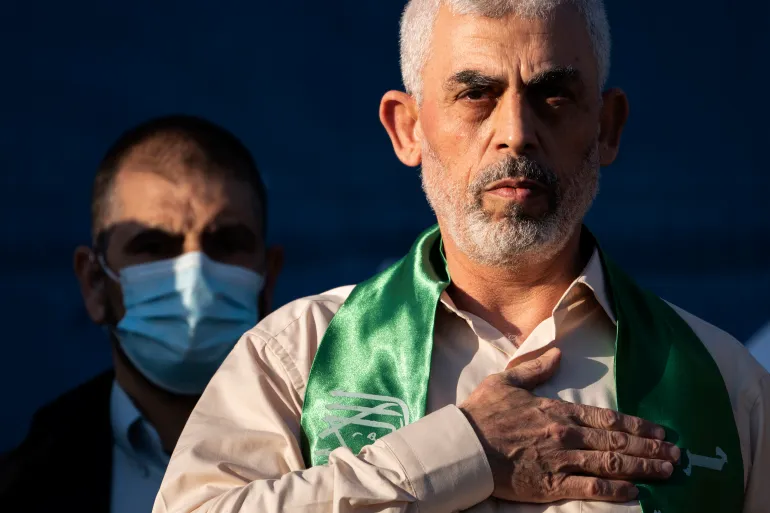
‘Spirit of resistance’: Hamas leader Yahya Sinwar

  • byAdmin
  • Oct 18, 2024

Hamas leader Yahya Sinwar has been confirmed dead by both Hamas and the Israeli military. Israel claims that Sinwar was killed during an operation, with the Israeli military stating they had positively identified his body on Thursday, following his death the previous day. Hamas confirmed Sinwar’s death on Friday evening. Iran’s delegation to the United Nations referred to Sinwar as a “martyr,” highlighting his role in the battlefield and claiming that his example would bolster the “spirit of resistance.” In a post on X (formerly Twitter), the mission noted how Sinwar’s visible presence on the battlefield, in combat attire and out in the open, rather than hiding, would inspire others to continue resisting. Al Jazeera’s Hani Mahmoud reported from Gaza on how Palestinians were reacting to the news. Even those who disagreed with Sinwar’s tactics viewed his death as honorable, seeing it as that of a warrior fighting against oppression. Throughout Israel’s year-long military campaign in Gaza, Sinwar had remained active, taking full leadership of Hamas following the assassination of its politburo chief Ismail Haniyeh in July, an act widely attributed to Israel. Under his leadership, Hamas continued its military activities, launching attacks on Israeli targets while also maintaining civil administration within Gaza, despite being targeted by Israeli forces. Sinwar had long been a target of the Israeli military, with multiple previous reports of his capture or death later proven false. Israeli officials had accused him, alongside Mohammed Deif (the commander of Hamas’s Qassam Brigades) and Marwan Issa (Deif’s deputy), of orchestrating the October 7 attack on Israel. In February, the Israeli military shared images it claimed showed Sinwar and his family inside a tunnel complex in Khan Younis, reportedly taken just after the October 7 attack. Israeli spokesperson Daniel Hagari also revealed during a briefing that Israeli forces had captured and were interrogating several members of Sinwar’s family, as well as the families of other Hamas leaders. There have been numerous reports, including from the United Nations, accusing Israel of using torture during interrogations. Sinwar, along with Haniyeh and Deif, was under investigation by the International Criminal Court (ICC) for alleged war crimes committed from at least October 7, 2023. All three have now been killed by the Israeli military. Remaining on the ICC’s list of individuals under investigation are Israeli Prime Minister Benjamin Netanyahu and Defense Minister Yoav Gallant. Yahya Sinwar, also known as Abu Ibrahim, was born in 1962 in a refugee camp in Khan Younis. His family had been displaced during the 1948 Nakba. Originally from the Palestinian village of al-Majdal, their land was razed, and the Israeli town of Ashkelon was built in its place. Sinwar was first arrested in 1982, before the age of 20, by Israeli authorities for his involvement in Islamic activities. Daniel Byman, a senior fellow at the Center for Strategic and International Studies, described Sinwar as a skilled leader, noting that his previous release as part of a prisoner exchange made him a significant figure for Israel. Analysts like Lovatt argue that while Sinwar was prominent in public, Deif was likely the true architect of the October 7 attack. However, Deif had not been seen publicly for years, and Israel claimed to have killed him in a July attack, although Hamas has yet to confirm his death. Before the assassination of Haniyeh, Sinwar was believed to have been involved in negotiations between Hamas and Israel regarding ceasefires and prisoner exchanges.

Read More

Dubai Police Extradite Wanted Criminal Faisal Taghi to Netherlands

  • Jul 29, 2024

Due to the unpredictable weather, all beaches, public parks, and marketplaces will be closed in Dubai.

  • May 2, 2024

The president of the UAE laments Sheikh Tahnoun bin Mohamed Al Nahyan's passing.

  • May 1, 2024

US

World

Diplomacy or Deterrence? The UN’s Role Amid Iran-Israel Escalation

  • byAdmin
  • Jun 20, 2025

As tensions flare across the Middle East, the world once again turns to the United Nations—not with hope, but with hard questions. Can the UN play a meaningful role in de-escalating the Iran-Israel conflict? Or is it relegated to the sidelines, issuing statements as the region edges toward war?

In an era marked by diplomatic fatigue, geopolitical fragmentation, and proxy warfare, the UN’s mission is being tested like never before. The crisis between Iran and Israel isn't just a regional flashpoint—it’s a global challenge demanding a coordinated international response.

But is diplomacy still viable? Or has deterrence become the only language understood?

The Current Flashpoint: Iran vs. Israel

Since October 2023, the Middle East has witnessed a dangerous surge in hostilities. Following the brutal Hamas attacks and Israel's military response in Gaza, Iran's regional proxies—including Hezbollah, the Houthis, and Shiite militias in Iraq and Syria—have ramped up operations, drawing Tehran and Jerusalem ever closer to direct confrontation.

The recent exchange of drone strikes, sabotage operations, and covert attacks has escalated fears of a full-scale regional war. The implications are immense:

  • Civilian casualties and refugee flows

  • Global oil supply disruptions

  • Nuclear proliferation concerns

  • The risk of U.S. or Russian involvement

Amidst this, the world asks: What is the United Nations doing?

The UN’s Role: Mandate vs. Reality

The United Nations was created to “save succeeding generations from the scourge of war.” Its role includes:

  • Mediating international disputes

  • Enforcing peace through Security Council resolutions

  • Deploying peacekeeping missions

  • Upholding international humanitarian law

Yet when it comes to the Iran-Israel crisis, the UN faces severe limitations:

  • Security Council gridlock, often due to veto powers exercised by the U.S., Russia, or China

  • Lack of enforcement power, especially with nuclear-armed or regionally dominant states

  • The complexity of proxy conflicts, which blur accountability

  • Erosion of trust, as many countries see the UN as biased or ineffective

Despite these constraints, the UN remains one of the few platforms where all stakeholders can still talk—if only behind closed doors.

Recent UN Actions (and Inactions)

Since the escalation began, the UN has taken several key steps:

  • Secretary-General António Guterres has repeatedly called for restraint, urging both Iran and Israel to avoid a broader war.

  • UNIFIL (United Nations Interim Force in Lebanon) has been caught in crossfire, trying to maintain calm along the Israel-Lebanon border.

  • Humanitarian agencies under the UN umbrella, including UNRWA and OCHA, continue to operate in Gaza, though under extreme duress.

  • Emergency Security Council sessions have been convened, often ending in division, with resolutions blocked or watered down.

Yet critics argue that these actions fall short, especially as both sides continue to escalate with impunity.

Diplomacy: Is There Still Room?

Some argue that despite the noise of war, quiet diplomacy is still possible—and necessary. The UN could play a role in:

  1. Backchannel Dialogue

    • Facilitating unofficial talks between Israeli and Iranian intermediaries

    • Involving neutral parties like Oman, Qatar, or Switzerland

  2. Ceasefire Frameworks

    • Similar to those used in previous Gaza conflicts

    • Negotiated through Egypt and the UN Special Coordinator for the Middle East Peace Process

  3. Proxy Containment

    • Urging Hezbollah and the Houthis to de-escalate through pressure on Iran

    • Providing diplomatic cover for disengagement

  4. Humanitarian Corridors

    • Especially in southern Lebanon or western Syria if the conflict spreads

But for diplomacy to work, both sides must want off-ramps. And currently, Iran and Israel are locked in a posture of deterrence and retaliation.

Deterrence: The Dominant Paradigm

In the absence of trust or dialogue, both nations have defaulted to military deterrence:

  • Israel’s “Octopus Doctrine” views Iran as the head behind regional proxies, justifying preemptive strikes deep into Iranian territory.

  • Iran’s “strategic patience” doctrine allows for slow, calculated responses, but it is increasingly under pressure from hardliners demanding retaliation.

The problem? Deterrence often relies on calibrated violence, and in a region this volatile, miscalculations are inevitable.

The UN, for its part, is not structured to navigate this logic. It excels in diplomacy, mediation, and conflict prevention—but deterrence belongs to the realm of military powers and strategic alliances.

The Veto Problem

Any meaningful UN action on this issue—especially through the Security Council—hits an immediate wall:

  • The U.S. consistently vetoes measures perceived as anti-Israel.

  • Russia and China block efforts that isolate Iran or empower Western-backed solutions.

This stalemate leaves the UN paralyzed—not by lack of will, but by lack of consensus.

And without consensus, resolutions are symbolic at best—and ignored at worst.

Global Implications of UN Inaction

If the UN fails to assert itself, the consequences are not just regional:

  • Erosion of International Law: If deterrence replaces diplomacy, international norms become irrelevant.

  • Diplomatic Fragmentation: Countries may bypass the UN and form rival coalitions, undermining multilateralism.

  • Empowerment of Proxy Warfare: Militias and non-state actors thrive in power vacuums.

  • Loss of Credibility: Future crises in Ukraine, Taiwan, or Africa could spiral without a trusted mediator.

In other words, the Iran-Israel conflict may become the latest—but not the last—example of the UN’s waning influence.

So, What Can the UN Do?

While limited, there are still avenues for impact:

  • Appoint a Special Envoy solely focused on Iran-Israel de-escalation

  • Empower regional platforms (like the Arab League) under UN sponsorship

  • Press for humanitarian ceasefires—even temporary ones—especially if the conflict spills into civilian zones

  • Highlight violations of international law, building moral and legal pressure

  • Support Track II diplomacy, where former diplomats and experts engage unofficially

The key is patience and persistence. The UN won’t end the conflict, but it can keep the door to diplomacy ajar.

Conclusion: Still Relevant, But Handcuffed

The United Nations stands at a crossroads. Its foundational mission of preserving peace remains more vital than ever—but its tools are dulled by great power rivalry, proxy politics, and institutional inertia.

In the Iran-Israel conflict, the UN must walk a tightrope between diplomacy and deterrence—even as its own relevance is questioned.

Yet, in a world teetering between chaos and order, even imperfect diplomacy is better than perfect war.

And for now, the UN remains one of the last global arenas where peace, however fragile, can still be pursued.


About Realtime Brief
Realtime Brief brings clarity to conflict. We unpack complex geopolitics with depth, accuracy, and urgency—because understanding the world shouldn’t wait.

Read More

The U.S. in the Crossfire: How American Bases in the Middle East Are at Risk

  • Jun 20, 2025

America’s Balancing Act: Can the U.S. Prevent a Regional War in the Middle East?

  • Jun 20, 2025

Iran vs. Israel: Is the Middle East on the Brink of a Full-Scale War?

  • Jun 20, 2025

Pakistan

World

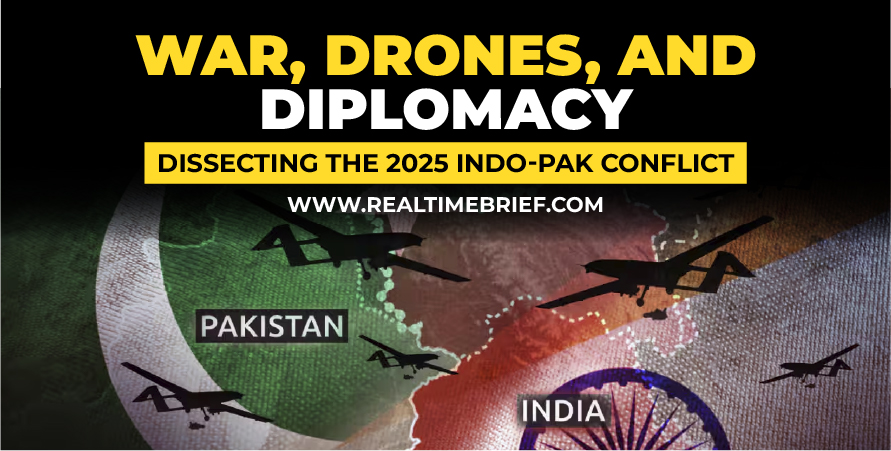
War, Drones, and Diplomacy: Dissecting the 2025 Indo-Pak Conflict

  • byAdmin
  • May 24, 2025

The 2025 India–Pakistan conflict stands as one of the most intense military escalations between the two nuclear-armed neighbors in recent decades. Triggered by a deadly terrorist attack in Indian-administered Kashmir, the crisis rapidly evolved into a series of military confrontations, diplomatic standoffs, and significant regional repercussions.


🔥 Origins of the Conflict: The Pahalgam Attack

On April 22, 2025, a terrorist attack in Pahalgam, a town in Indian-administered Kashmir, resulted in the deaths of 26 civilians, predominantly Hindu tourists. The militant group The Resistance Front (TRF) claimed responsibility. India accused Pakistan of supporting the attackers, an allegation Pakistan vehemently denied, suggesting instead an international inquiry into the incident.Wikipedia+7AP News+7CSIS+7WikipediaWikipedia+2Reuters+2Wikipedia+2


⚔️ Military Escalation: Operation Sindoor and Retaliation

In response, India launched "Operation Sindoor" on May 7, 2025, targeting alleged terrorist camps in Pakistan and Pakistan-administered Kashmir. The operation involved missile and air strikes on nine locations, including areas in Bahawalpur and Muridke, believed to be hubs for Jaish-e-Mohammed and Lashkar-e-Taiba. India asserted that the strikes were precise and avoided civilian casualties. However, Pakistan reported that the attacks resulted in 31 civilian deaths, including in mosques. The Times of India+5Wikipedia+5Council on Foreign Relations+5Wikipedia+1Reuters+1

Pakistan retaliated with "Operation Bunyan-un-Marsoos," claiming to target several Indian military bases. The conflict marked the first drone warfare engagement between the two nations, with both sides employing unmanned aerial vehicles for strikes and reconnaissance.Reuters+2Wikipedia+2Wikipedia+2


📊 Casualties and Damage

  • Indian Claims: India reported eliminating over 100 militants during its operations.

  • Pakistani Claims: Pakistan stated that Indian strikes killed 31 civilians and that their forces shot down multiple Indian aircraft, including Rafale jets. However, independent verification of these claims remains inconclusive.

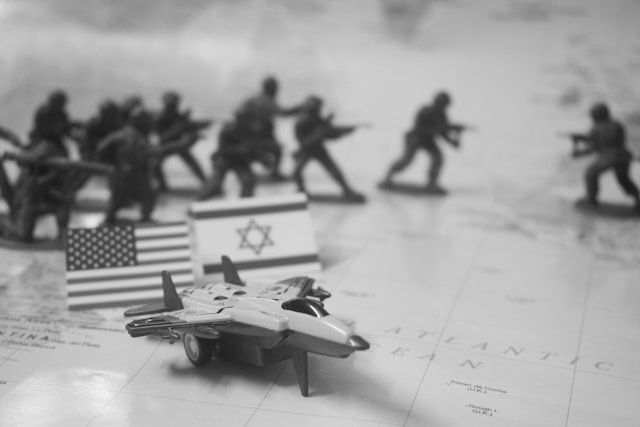
  • Overall Impact: The conflict resulted in significant infrastructural damage on both sides, including airbases and civilian areas.Reuters+14Reuters+14Wikipedia+14Reuters+4Wikipedia+4Wikipedia+4


🌐 Diplomatic Fallout

The hostilities led to a severe diplomatic breakdown:@EconomicTimes+1Reuters+1

  • India:

    • Suspended the Indus Waters Treaty, affecting water flow to Pakistan.

    • Expelled Pakistani diplomats and suspended visa services for Pakistani nationals.

    • Closed border crossings and halted trade relations.The Times of India+3Reuters+3Wikipedia+3Reuters+2Wikipedia+2The Times of India+2

  • Pakistan:

    • Responded by suspending the Simla Agreement.

    • Closed its airspace to Indian aircraft.

    • Expelled Indian diplomats and imposed trade restrictions. Council on Foreign Relations+3The Times of India+3Wikipedia+3Wikipedia+1Wikipedia+1Reuters

Both nations launched international diplomatic campaigns to garner support, with India emphasizing its counter-terrorism stance and Pakistan highlighting alleged human rights violations by India in Kashmir.Financial Times+1AP News+1


🕊️ Ceasefire and Mediation

A ceasefire was brokered on May 10, 2025, following interventions by international actors, including the United States. Despite the ceasefire, sporadic skirmishes and mutual distrust persist, with both sides accusing each other of violations.AP News+5Wikipedia+5Wikipedia+5Al Jazeera


📉 Economic and Social Impact

  • Kashmir Tourism: The region's tourism industry suffered a massive blow, with occupancy rates plummeting and widespread cancellations, severely impacting the local economy .

  • Public Sentiment: In Pakistan, support for the military surged, with General Asim Munir being promoted to Field Marshal and receiving widespread public approval for his leadership during the conflict .AP NewsReuters


🔮 Outlook


While active hostilities have ceased, the underlying tensions and unresolved issues between India and Pakistan remain. The international community continues to monitor the situation closely, emphasizing the need for sustained dialogue and conflict resolution mechanisms to prevent future escalations.

Read More

ICJ Criticizes “Blow to Judicial Independence” as 26th Constitutional Amendment Becomes Law

  • Oct 22, 2024

Military Detaining Former ISI Chief Faiz Hameed, Pending a Judicial Martial

  • Aug 12, 2024

Bangladesh Protests Live: PM Sheikh Hasina Resigns, Interim Government to Take Over

  • Aug 5, 2024

Saudi Arabia

World

Beast House departs Saudi Arabia on a special musical mission.

  • byAdmin
  • May 3, 2024

RIYADH: In just a few months after its debut, Beast House has grown to be one of the most valuable assets in the Saudi music scene. It does this by utilizing MDLBEAST's all-encompassing approach to provide the Saudi music business with a strong foundation.


With an inventive tripod model that blends music, architecture, and technology to accomplish its distinct mission in the nation, Beast House represents MDLBEAST's first investment in the music facilities sector in Saudi Arabia. The project is motivated by a vision to provide a fertile ground in which to cultivate the region's music culture.


Ramadan Alharatani, CEO of MDLBEAST, told Arab News exclusively: “We see Beast House becoming a cornerstone of Riyadh’s music scene, a place where creativity is nurtured and talents from the local and international scenes can grow. Our vision is to revolutionize the way music is experienced in the region by fostering connections in the creative community through the power of music.”


With live music events, workshops, studio spaces, and communal dining areas, the multitiered members-only location offers an immersive experience for music producers, industry professionals, creatives, and enthusiasts to interact and learn.


“Beast House creates a platform for local artists to both showcase and hone their talents. In this space, members can collaborate with other artists through our diverse programming designed to elevate the experience of artists. It’s a welcoming space for anyone still finding their creative path,” Alharatani said.


The studio features a mix room with a Solid State Logic Origin mixing console, a Neve recording room with a modern vibe, and two music production rooms with recording booths.


According to Alharatani, Beast House Studio uses a combination of contemporary digital and analog technology to serve artists of all skill levels. We provide practical expertise with all aspects of production, including mixing, mastering, and recording.


“Our backline includes Fender guitars, Yamaha drums, and world-class microphones like Neumann, Royer, and AKG, alongside high-end outboard gear such as Neve, Bricasti, and UA 1176 compressors. We also provide a comprehensive selection of synths and drum machines from renowned brands like Roland, Moog, and Sequential, along with top-tier software and plugins including Pro Tools, Ableton, and Waves, offering artists endless sonic possibilities.”


Beast House is all about engaging the senses in a friendly environment with its design, carefully crafted playlists, refreshments, and dynamic live concerts, according to the CEO, who also stated that these places are vital for a burgeoning music scene and supporting the industry.


He said: “By offering insight into songwriting, production, and the music business, we’re enabling the growth of local talent and opportunities. This fosters job creation, draws in tourism, and stimulates local businesses, which are key components in building a robust music infrastructure.”


However, adding more venues to the Kingdom is just one aspect of MDLBEAST's agenda.


“Our strategy is built on three pillars — music and artists, live events, and venues — and through these three pillars, we can create a vivid music scene and opportunities for local and global artists to constantly engage with their audience,” Alharatani said. “All this leads to two main goals: support the innovative economy and entertainment tourism in the Kingdom, and guarantee the sustainability of our events.”


Since this is the first private members' club of its kind in Saudi Arabia, and some people in the country may not be familiar with it, Alharatani thinks that educating the public will be essential to encouraging people to commit to memberships.

Read More

The housing minister meets with Chinese officials to further the goals of Vision 2030 and strengthen Sino-Saudi collaboration.

  • May 3, 2024

The tall juniper tree represents the splendor of Al-Baha.

  • May 3, 2024

Russia

World

China, Russia, and the New Axis: Is a Global Realignment Underway?

  • byAdmin
  • Jun 20, 2025

For decades, the United States and its Western allies have shaped the global order through military power, economic dominance, and institutional influence. But today, that order is under challenge like never before.

Enter China and Russia — two authoritarian powers growing increasingly aligned in both vision and strategy. Amid wars, sanctions, and ideological divides, a new axis of power seems to be forming—one that aims to reshape the global balance, weaken Western dominance, and offer alternative models of governance, trade, and security.

So the question arises: Is a global realignment truly underway? And if so, what does it mean for the future of world order?

The Strategic Bond: From Convenience to Coordination

Historically, China and Russia were ideological rivals, even during the Cold War. But in the 21st century, shared strategic interests have drawn them together:

  • Anti-U.S. Sentiment: Both nations view American hegemony as a direct threat to their sovereignty and ambition.

  • Authoritarian Governance: They promote state-centric political systems over Western liberal democracies.

  • Economic Complementarity: China needs resources; Russia has them. Russia needs tech and markets; China provides both.

  • Global Disruption: Both aim to undermine the rules-based order set by institutions like the UN, IMF, and NATO.

In 2022, just days before Russia invaded Ukraine, Xi Jinping and Vladimir Putin declared a “no-limits partnership.” This wasn’t mere diplomacy—it was a signal that the geopolitical tectonics were shifting.

War in Ukraine: A Catalyst for Closer Ties

The war in Ukraine has served as a litmus test for global alliances. While the West responded with sanctions and weapons, China doubled down on its strategic neutrality—criticizing NATO, buying discounted Russian oil, and expanding diplomatic ties with Moscow.

Despite international pressure, China has refused to condemn Russia’s invasion and has instead positioned itself as a “peace broker”—a narrative that masks its quiet support and growing influence.

Meanwhile, Russia’s isolation from the West has made it more dependent on China than ever before, giving Beijing the upper hand in this increasingly asymmetric partnership.

Multipolarity: A World Beyond the West

Beijing and Moscow’s vision is clear: a multipolar world where no single power dominates. And they’re not alone. Other nations—whether by ideology, necessity, or resentment—are joining this shift:

  • Iran has forged military ties with Russia, supplying drones used in Ukraine.

  • North Korea is drawing closer to both Moscow and Beijing.

  • Venezuela, Cuba, and parts of Africa are engaging in bilateral deals that bypass Western systems.

  • India, Brazil, and South Africa—while not anti-Western—are also advocating for strategic autonomy through frameworks like BRICS.

This isn’t just rhetoric. It reflects a growing disenchantment with U.S.-led globalization, sanctions regimes, and perceived Western double standards.

Economic Tools of Realignment

China and Russia are also building alternative economic infrastructures to reduce dependency on the West:

  • De-dollarization: Russia now trades oil in yuan with China and rupees with India, sidestepping the U.S. dollar.

  • Cross-Border Payment Systems: China’s CIPS and Russia’s SPFS are rivals to SWIFT.

  • Energy Corridors: The Power of Siberia gas pipeline connects Russian fields to Chinese markets, and more projects are underway.

  • Digital Silk Road: Through 5G, cloud infrastructure, and AI exports, China is becoming a tech patron for developing nations.

This economic realignment is not just about transactions—it’s about influence, leverage, and long-term control.

Military and Security Ties

While China and Russia stop short of a formal alliance like NATO, their military cooperation is growing:

  • Joint naval exercises in the Sea of Japan, the South China Sea, and even the Arctic.

  • Air patrols over strategic areas near Japan and Korea.

  • Military-technical collaboration, especially with Iran and North Korea in the mix.

This signals a convergence of strategic interests across Eurasia, particularly in countering U.S. presence in East Asia, Europe, and the Middle East.

Global South: The Battleground of Influence

One of the biggest implications of this new axis is its rising appeal in the Global South. Many countries in Africa, Latin America, and Southeast Asia are:

  • Tired of Western conditional aid

  • Attracted by no-strings-attached infrastructure deals from China

  • Open to Russian arms and grain in the face of Western neglect

This doesn’t mean they’re choosing sides—it means they’re choosing flexibility. China and Russia offer them bargaining power, and that’s a potent force in a rapidly shifting world.

The U.S. and Europe: Struggling to Adapt?

While NATO has found renewed purpose post-Ukraine, and the U.S. remains the dominant military power, Western influence is being tested:

  • Afghanistan withdrawal damaged U.S. credibility.

  • Sanctions fatigue is setting in among non-Western countries.

  • Domestic political polarization in the U.S. and Europe weakens long-term strategic consistency.

Without a clear, cohesive counter-strategy, the West risks reacting to change rather than shaping it.

Is the New Axis Durable?

Not necessarily.

  • Russia is economically weakened and increasingly a junior partner to China.

  • China faces internal challenges—from a slowing economy to demographic collapse.

  • Differing interests (e.g., Russia’s aggression vs. China’s cautious diplomacy) could cause friction.

Yet, even a temporary, pragmatic alliance can cause long-term shifts, especially if Western alliances are slow to respond.

Conclusion: A Realignment in Motion

We are witnessing more than a partnership—we are seeing a geostrategic realignment in motion. The China-Russia axis, though not formalized like past alliances, is changing the way power is distributed and exercised across the globe.

The world is not becoming bipolar again—it’s becoming fluid, fragmented, and fiercely contested.

For the West, the challenge is not only to contain this axis but to rebuild trust with the Global South, invest in resilient partnerships, and offer a compelling alternative vision.

Whether it’s in Beijing, Moscow, or Brasília, the message is becoming clear: the age of unipolarity is over. What comes next is still being written.

About Realtime Brief
Realtime Brief delivers clear, fact-driven, and timely insights into the world’s most pressing geopolitical trends. From the corridors of Beijing to the Kremlin and beyond, we help you stay ahead of the global curve.

Read More

Ukraine's Strategic Dilemma: Holding or Withdrawing from Seized Russian Territory

  • Aug 13, 2024

Russian antiviral company After a prohibition, Kaspersky leaves the US

  • Jul 16, 2024

Zelensky of Ukraine is added to Russia's wanted list, according to TASS.

  • May 4, 2024

India

World

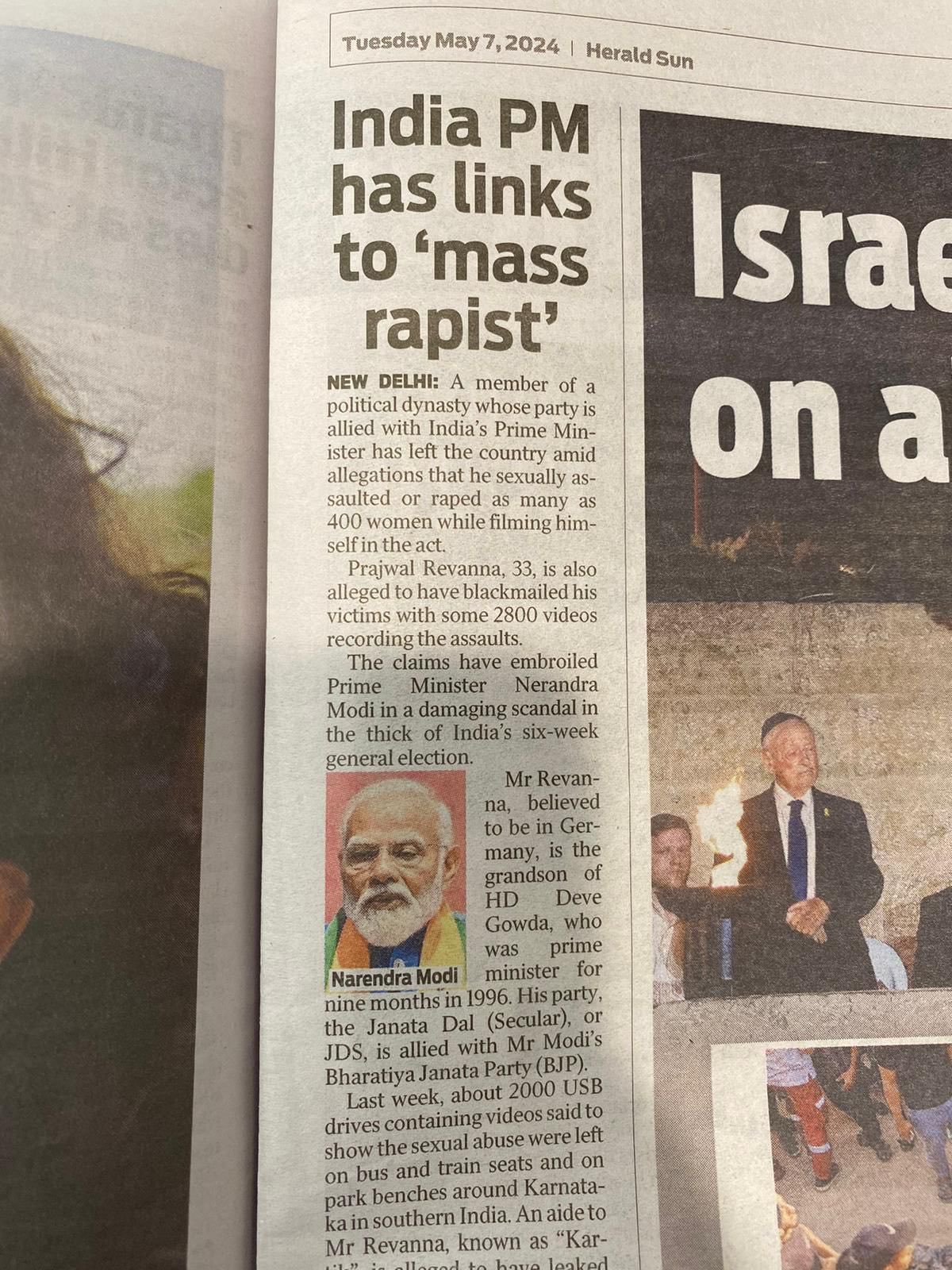
Nerandra Modi ‘knew ally was a mass rapist’

  • byAdmin
  • May 8, 2024

A political dynasty scion who is associated with the prime minister of India has reportedly sexually attacked or raped up to 400 women while recording the incident on camera. According to reports, the scion fled the country.

Additionally, it is claimed that 33-year-old Prajwal Revanna blackmailed his victims by showing them almost 2800 tapes of the assaults. In the midst of India's six-week general election, Nerandra Modi has become engaged in a severe scandal due to the claims.

The grandson of south Indian prime politician HD Deve Gowda, who served as prime minister for nine months in 1996, Revanna is thought to be in Germany.

In Karnataka, Modi's Bharatiya Janata Party (BJP) is partnered with his party, the Janata Dal (Secular), or JDS.

Approximately two thousand USB drives, purportedly holding videos of sexual abuse, were discovered last week scattered across park benches and bus and train seats in Karnataka. After a falling out with Revanna a year ago, her driver and assistant, only known as "Kartik," is said to have leaked them.

Modi's appearances at rallies with Revanna have been used by the opposition Congress Party to undermine his campaign. Modi's Hindu nationalism has not been well received in the southern states, thus the BJP has leveraged its partnership with the JDS to establish a presence there.
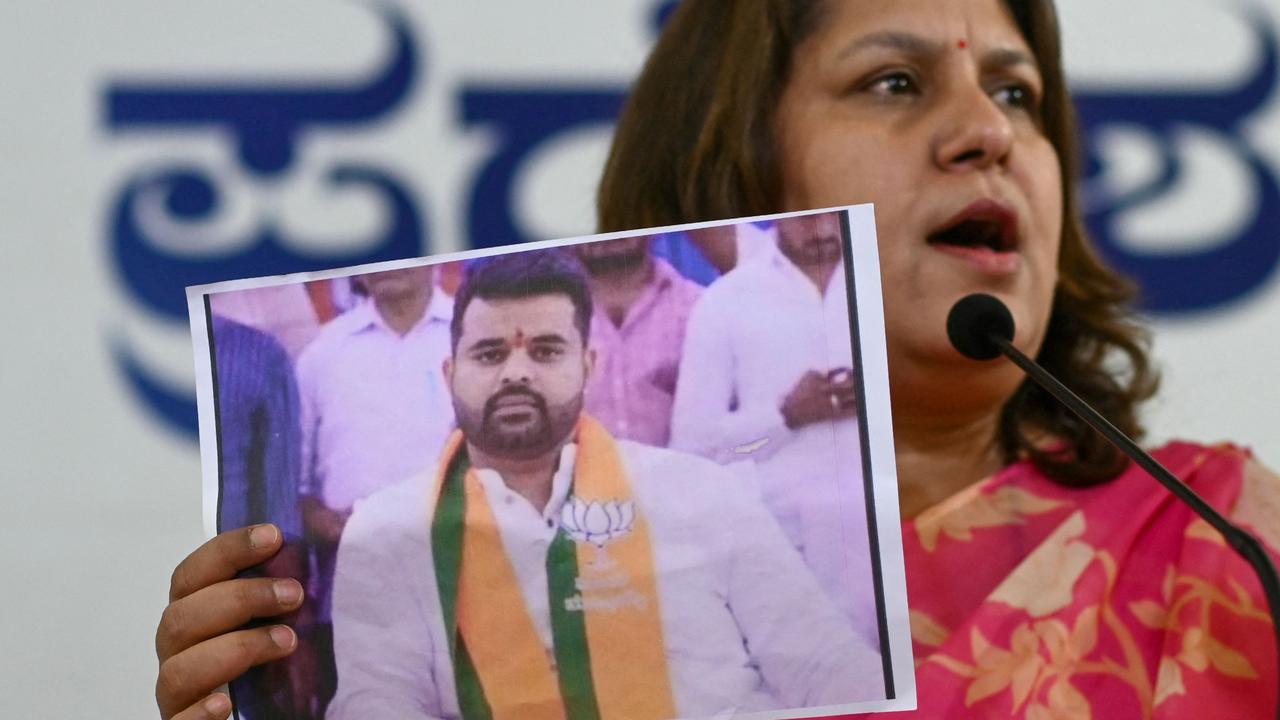
Congress spokesperson Supriya Shrinate shows a photograph featuring Prajwal Revanna, who was summoned for alleged sexual abuse case. Picture: AFP

The head of the Congress, Rahul Gandhi, said that Modi and other party officials knew about the films prior to their release. Gandhi said at a Karnataka rally, "This is a mass rape, not a sex scandal." "A mass rapist has the prime minister's support." Even though Prajwal Revanna is a serial rapist, all BJP leaders remained loyal to him and supported him in the election.

Reporters were informed by one of the accused victims, a former Bangalore local councillor, that she had been beaten for three years. She said, "I denied him and said I would scream for help when he asked me to take off my clothes." Then, claiming to be holding a pistol, he threatened me.

"Then, claiming to be holding a pistol, he threatened me. If I told anyone about the video, he threatened to make it public. He used to ask me to strip during video calls. I was also raped by him multiple times."

Revanna filed a police complaint before departing for Germany, alleging that the tapes were "doctored" and were being distributed in an effort to "tarnish his image and poison voters' minds."

After one of Revanna's previous housemaids came forward and claimed that he had raped her on multiple occasions, a police complaint was made against her. The head of the Karnataka Women's Commission, Dr. Nagalakshmi Chowdhary, declared, "Watching those videos is very terrible." "Your blood boils from it." The individual in the recordings could be "clearly made out," according to her.

HD Revanna, Revanna's father, was taken into custody on Saturday after the maid reported that she had been beaten by him at a property that belonged to his assistant.

His son has been suspended by the JDS while the state government conducts an investigation.
 

Read More

Africa

World

Second-Largest Diamond in History Discovered in Botswana

  • byAdmin
  • Aug 22, 2024

A remarkable 2,492-carat diamond, the second-largest ever found, has been uncovered in Botswana at a mine owned by Canadian company Lucara Diamond. This discovery is the largest since the 3,106-carat Cullinan diamond, which was unearthed in South Africa in 1905 and later cut into nine separate stones, several of which now form part of the British Crown Jewels.

The massive diamond was discovered at the Karowe mine, located about 500 kilometers (300 miles) north of Botswana’s capital city, Gaborone. According to Botswana's government, this is the largest diamond ever found within the country.

Previously, the biggest diamond discovered in Botswana was a 1,758-carat stone, also found at the Karowe mine in 2019. Botswana is among the world’s top diamond producers, accounting for around 20% of global production.

In a statement, Lucara Diamond confirmed that the gem is "one of the largest rough diamonds ever discovered." William Lamb, the head of Lucara, expressed excitement over the find, saying, "We are thrilled with the recovery of this extraordinary 2,492-carat diamond."

The diamond was detected using Lucara's Mega Diamond Recovery X-ray technology, a system implemented in 2017 to help identify and protect large, valuable diamonds from damage during the ore-crushing process.

Details regarding the gem's quality and value were not disclosed. The 1,758-carat diamond discovered in 2019 was purchased by luxury fashion brand Louis Vuitton for an undisclosed amount. In 2017, a 1,109-carat diamond found in 2016 at the same mine was sold for $53 million (£39.5 million) to Laurence Graff, chairman of Graff Diamonds.

Lucara Diamond holds full ownership of the Karowe mine. Recently, Botswana’s government proposed legislation requiring companies granted mining licenses to sell a 24% stake to local businesses if the government chooses not to become a shareholder, according to a report from Reuters last month.

Read More

Lawyer: Kenyan serial killer suspect was tortured until he confessed.

  • Jul 16, 2024

South Korea

World

Charged with Spying for South Korea Is an Ex-Cia Analyst.

  • byAdmin
  • Jul 17, 2024

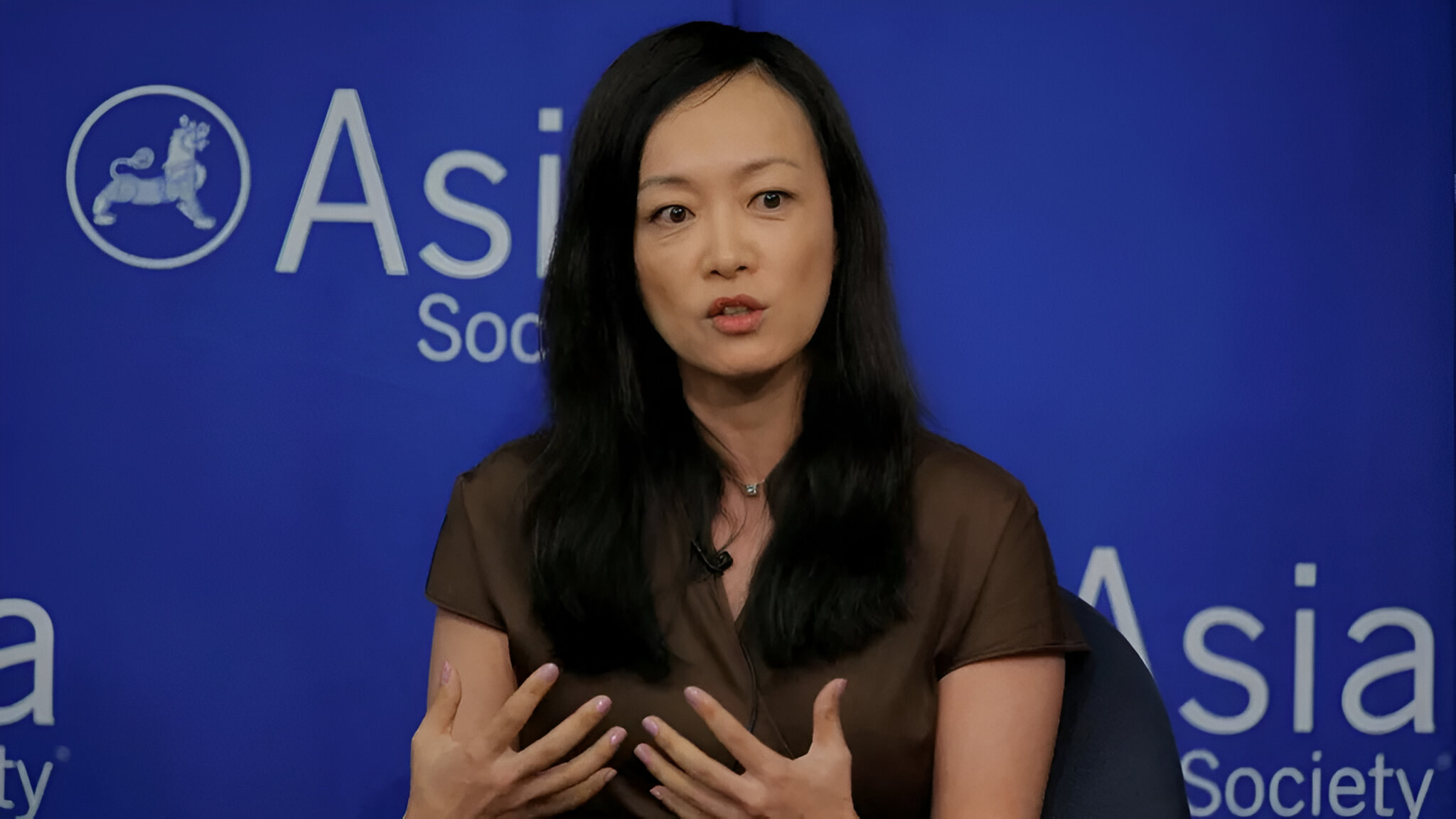
A Former Us Central Intelligence Agency Analyst Has Been Charged by A Grand Jury in New York with Serving as A Spy for The South Korean Government in Exchange for Money, Designer Items, Travel Bags, and Elaborate Meals.


Sue Mi Terry, a Former Senior Officer in The White House National Security Council, Is Charged with Two Charges of Conspiracy to Violate the Foreign Agents Registration Act and Failing to Register as A Foreign Agent.


Court Filings Made Public in The Southern District of New York on Tuesday Reveal that Ms. Terry, a Well-Known Us Authority on North Korea, Served as An Agent for The South Korean Government for More than Ten Years without Registering as A Foreign Agent with Us Authorities.
 

According to A Representative Who Talked to Us Media, Ms. Terry Has Been Placed on Unpaid Leave by The Council on Foreign Relations, a Think Group Where She Serves as A Senior Fellow on Asia. Her Biography Has Also Been Taken Down from The Organization's Website.


Ms. Terry, 54, Is Accused of Being "unfounded" in The Accusations, According to Her Lawyer Lee Wolosky, Who Also Stated that She Denies the Charges.


According to Mr. Wolosky, the Accusations "distort the Work of A Scholar and News Analyst Known for Her Independence and Years of Service to The United States". "in Fact, She Was a Harsh Critic of The South Korean Government During Times This Indictment Alleges that She Was Acting on Its Behalf."

According to Ms. Terry's Former Employment at Columbia University, She Was Born in South Korea and Immigrated to The Us at The Age of Twelve.


She Graduated with A Doctorate in 2001 from Tufts University's Renowned Fletcher School of Law and Diplomacy, a Prestigious International Relations Institution in Massachusetts. Her Lectures in Korean and English Are Well-Known.


After Serving in A Number of Federal Government Positions, Including Director for Korea, Japan, and Oceanic Affairs at The National Security Council Under the George W. Bush and Barack Obama Administrations, Ms. Terry, 54, Continued Her Career as A Senior Analyst for The Cia from 2001 to 2008.

According to The Prosecution, Ms. Terry Quit Working for The Cia and The National Security Council in 2013, Which Is Roughly Five Years Ago. at That Point, She Started Acting as An Agent for The South Korean Government.


According to The 31-Page Complaint, Ms. Terry Acknowledged Being a “source” for South Korea’s National Intelligence Service to Fbi Investigators During a Voluntary Interview in 2023.


The Indictment Claims that Ms. Terry Received Gifts from The South Korean Government Including a $3,450 Louis Vuitton Handbag, a $2,845 (£2,100) Dolce & Gabbana Coat, and Dinners at Posh Restaurants.

According to Officials, the Government Also Provided Her $37,000 and Devised a Scheme to Conceal the Monies' Source, Putting Them in A Gift Fund at The Think Group Where She Was Employed.


The indictment of Ms. Terry was only made one day after Democratic Senator Robert Menendez was found guilty of providing assistance to foreign governments in exchange for opulent gifts like gold bars and a Mercedes.


Read More

Bangladesh

World

Investigation starts against former Bangladesh PM Hasina, 9 others for genocide, crimes against humanity

  • byAdmin
  • Aug 15, 2024

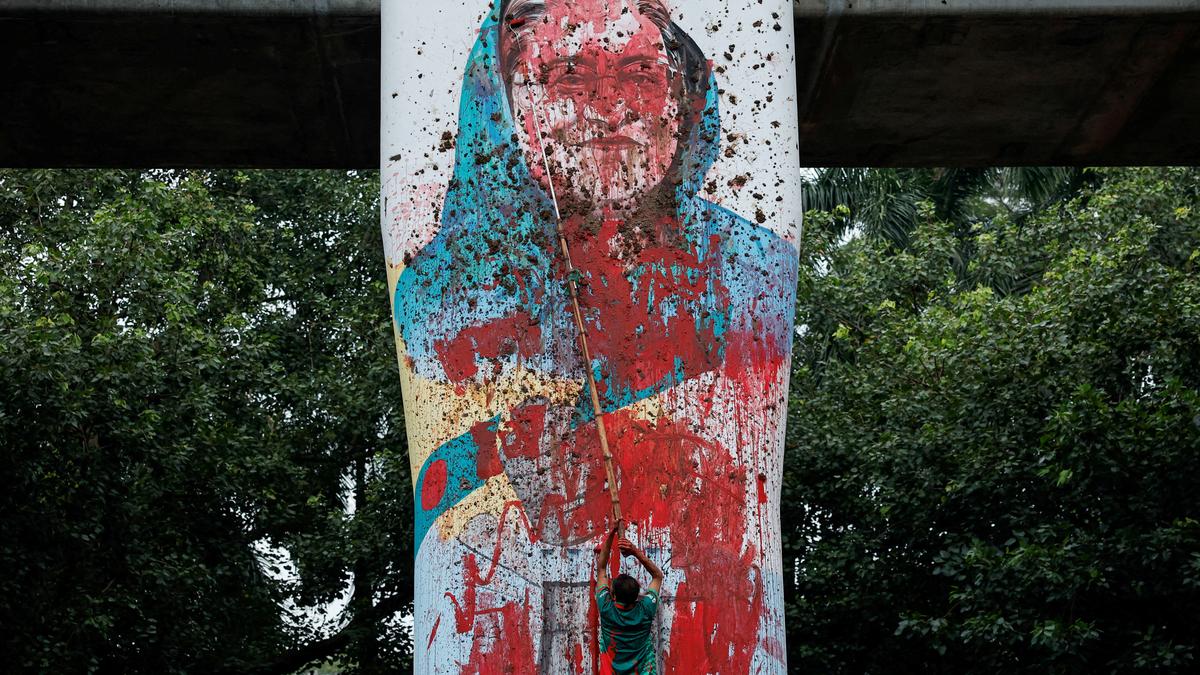
Bangladesh’s International Crimes Tribunal has launched an investigation into former Prime Minister Sheikh Hasina and nine other individuals on allegations of genocide and crimes against humanity. These charges relate to the period from July 15 to August 5, during which a significant student-led movement took place against Hasina’s government.

On August 14, 2024, a formal complaint was filed with the Tribunal's investigative body by Bulbul Kabir, the father of Arif Ahmed Siam, a Class IX student who died during the protests. The complaint accuses Hasina, Awami League General Secretary and former Road Transport and Bridges Minister Obaidul Quader, former Home Minister Asaduzzaman Khan Kamal, and other key figures within the Awami League of orchestrating a violent crackdown on the protestors, leading to numerous casualties and severe human rights violations.

The Tribunal began its investigation on the night of August 14, according to Gazi M.H. Tamim, the lawyer representing the complainant, as reported by The Dhaka Tribune.

The charges against Hasina and her associates come at a time when the interim government has announced that killings occurring between July 1 and August 5 will be prosecuted by the International Crimes Tribunal.

In addition to these allegations, on August 14, 2024, a separate case of enforced disappearance was filed against Hasina and several of her former cabinet members, accusing them of abducting a lawyer in 2015. Another murder case was filed on August 13, 2024, implicating Hasina and six others in the death of a grocery shop owner during the violent clashes that contributed to the downfall of her government.

On August 15, 2024, a Dhaka court instructed police to submit a report by September 15 regarding the investigation into the death of Abu Saeed, the grocery shop owner, who was killed by police gunfire during quota reform protests in Mohammadpur on July 19.

The student-led protests, initially focused on demanding changes to government job quotas, escalated into a broader movement that ultimately led to the fall of the Hasina government in early August. The violence that ensued during this period resulted in over 230 deaths, bringing the total death toll to 560 over three weeks of unrest.

Following Hasina’s resignation, a caretaker government led by Nobel laureate Muhammad Yunus was established, with a commitment to pursue administrative and political reforms and ensure accountability for the violence.

Read More

Soldiers were spotted having fun with protestors.

  • Aug 5, 2024

A statue of Sheikh Mujibur Rahman, the father of Ms. Hasina, was attempted to be destroyed by demonstrators.

  • Aug 5, 2024

Following her departure from the nation, demonstrators seized Prime Minister Sheikh Hasina's palace.

  • Aug 5, 2024

China

World

China's Silent Watch: Why Beijing Is Staying Quiet on Iran-Israel Tensions

  • byAdmin
  • Jun 20, 2025

As the Middle East simmers with renewed tensions between Iran and Israel, one global superpower has adopted a conspicuously quiet posture: China.

While the United States deploys naval fleets and issues statements, and Europe scrambles to prevent a wider war, Beijing has remained strategically silent, offering minimal public commentary and no direct condemnation or support for either side. For some, this looks like passivity. For those reading between the lines, it’s part of a deeper, calculated strategy.

So why is China staying quiet while the Middle East edges closer to a regional war?

A Quiet Power with Expanding Influence

China’s silence should not be mistaken for disinterest. Over the past decade, Beijing has quietly expanded its economic, political, and strategic influence across the Middle East:

  • Iran is a major partner in China's Belt and Road Initiative (BRI), and under a $400 billion cooperation deal, China has promised long-term investments in Iran's energy and infrastructure sectors.
  • Saudi Arabia, UAE, and Qatar have all deepened trade ties with China, particularly in the energy sector.
  • In 2023, China brokered a surprise rapprochement between Iran and Saudi Arabia, signaling its ambition to be more than just an economic player—it wants to shape regional diplomacy.

In short, China is now a stakeholder in Middle Eastern stability, but unlike the U.S., it is playing a long, quiet game.

Strategic Ambiguity: The Heart of China's Foreign Policy

China's approach to international conflict is rooted in non-interventionism—a doctrine that emphasizes state sovereignty and rejects public alignment in most foreign disputes. This allows China to:

  • Maintain good relations with conflicting states (Iran and Israel, in this case)
  • Avoid the costs and backlash of entanglement in regional wars
  • Position itself as a neutral economic partner rather than a geopolitical rival

By not taking sides in the Iran-Israel confrontation, China is avoiding alienating any of its partners and keeping its diplomatic doors open.

Iran: Quiet Support, Loud Profits

China has long stood by Iran in international forums, most notably by opposing harsh UN sanctions and continuing oil imports in defiance of U.S. pressure. Yet Beijing’s support is largely pragmatic, not ideological.

  • Iran provides China with discounted oil, bypassing Western markets and enabling energy security.
  • China has helped Iran navigate around Western sanctions via banking and currency swaps.
  • At the same time, China avoids overt military support, wary of triggering U.S. retaliation or damaging its relationships with the Gulf states and Israel.

Beijing is essentially profiting from Iran’s isolation, while steering clear of any open conflict that might damage trade stability.

Israel: A Strategic Tech and Trade Partner

While China enjoys deepening ties with Iran, it also has valuable commercial links with Israel, particularly in:

  • Technology and innovation sectors (cybersecurity, AI, medical tech)
  • Ports and infrastructure projects, including Chinese firms helping operate Haifa port until recently
  • Bilateral trade, which reached $20+ billion in recent years

Any open criticism of Israel—or visible tilt toward Iran—could jeopardize China’s access to Israeli innovation and spark a backlash from Israel’s Western allies.

Thus, Beijing walks a careful line, ensuring its silence doesn’t become a liability on either side.

Avoiding America’s Trap

There’s another layer to China’s strategy: letting the U.S. bleed diplomatically.

As America shoulders the burden of conflict management—sending military assets, issuing warnings, and facing domestic criticism—China avoids involvement and gains diplomatic leverage. In moments of chaos, Beijing can pose as a calm, non-aligned alternative to the “interventionist West.”

This calculated distance also helps China preserve its image among the Global South, where anti-American sentiment remains high and neutrality is seen as wisdom, not weakness.

What China Is Saying: Reading Between the Lines

Though public statements are minimal, Chinese officials have occasionally offered standard diplomatic lines:

  • Calls for “restraint from all parties”
  • Opposition to “external interference”
  • Emphasis on “dialogue and peaceful resolution”

These generic positions allow China to maintain a diplomatic presence without real commitment, avoiding the reputational cost of silence while offering no real solution.

But make no mistake: this silence is not ignorance—it is intention.

Could China Act as a Mediator?

Some believe Beijing’s successful brokering of the Iran-Saudi deal in 2023 shows it could step up as a peacemaker in future regional conflicts. However, the Iran-Israel dynamic is vastly more complex:

  • It involves nuclear threats, existential stakes, and decades of proxy warfare.
  • China lacks the deep military or intelligence presence in the region that the U.S. enjoys.
  • Both Iran and Israel view mediation through different ideological lenses—Tehran may welcome Chinese involvement, but Israel is far more aligned with Western frameworks.

Thus, while China could offer itself as a future mediator, it is unlikely to be effective—or even welcome—in this specific conflict.

Conclusion: Strategic Silence, Not Indifference

In a world where diplomacy is often loud and reactive, China’s quietude stands out. But beneath the surface, Beijing is playing a longer game:

  • Preserve access to both Israeli and Iranian markets.
  • Avoid confrontation with the U.S. in yet another region.
  • Maintain stability for its economic projects and energy security.
  • Position itself as the calm counterweight to American militarism.

As the Middle East inches closer to wider war, China is watching—carefully, quietly, and very much with intent.

About Realtime Brief
At Realtime Brief, we break down the world’s biggest conflicts, global shifts, and foreign policies—so you don’t have to. Stay informed, stay ahead.

Read More

Iran

World

Global Oil Markets and the Iran-Israel Conflict: Is a Price Shock Coming?

  • byAdmin
  • Jun 20, 2025

As tensions flare between Iran and Israel, global oil markets are once again sitting on a geopolitical fault line. With both nations capable of disrupting key energy corridors and drawing in wider regional players, the question on everyone's mind is: Are we on the verge of another oil price shock?

The short answer is — not yet, but the risk is growing by the day.

With the Strait of Hormuz under scrutiny, Houthi strikes in the Red Sea threatening shipping lanes, and Western powers deploying naval assets to secure trade routes, the Iran-Israel conflict is becoming a direct threat to the global energy supply chain. For countries dependent on Middle Eastern oil—and consumers worldwide—this has serious consequences.

Why Oil Markets React to Middle East Conflict

Oil markets are not just driven by supply and demand—they’re driven by fear, speculation, and geopolitics. Roughly 30% of the world’s oil passes through the Middle East, and any threat to production or transit routes can spark sharp price reactions.

Historically, conflicts in the region have caused massive market swings:

  • The 1973 Arab Oil Embargo quadrupled prices.
  • The Iran-Iraq War in the 1980s disrupted Gulf oil exports.
  • The 2003 Iraq War led to major volatility and long-term instability.
  • Even short-term flare-ups, like drone attacks on Saudi oil fields in 2019, sent crude prices soaring over 15% in one day.

Today, the situation may be more complex, but the stakes are no less dangerous.

What’s Happening in the Iran-Israel Theater?

Following Hamas’ October 2023 attacks on Israel, Tehran-backed proxies such as Hezbollah, the Houthis, and militias in Iraq and Syria have intensified regional operations. In retaliation, Israel has launched strikes on Iranian interests in Syria and covert operations inside Iran itself.

While both Iran and Israel have avoided direct war so far, a single miscalculation could escalate into a broader regional conflict—one that spills over into global trade and energy markets.

The key risk for oil markets is not just violence, but where that violence occurs.

The Chokepoints That Matter

  1. Strait of Hormuz

    • The world’s most important oil chokepoint.

    • Over 20% of global oil and nearly 25% of global LNG flows through it.

    • Iran has repeatedly threatened to block or mine the Strait in the event of a direct conflict.

  2. Bab el-Mandeb & Red Sea

    • Key shipping route for oil from the Persian Gulf to Europe and the West via the Suez Canal.

    • The Houthi rebel attacks on vessels in this region have already disrupted oil and container traffic.

  3. Abqaiq and Gulf Infrastructure

    • Saudi Arabia and the UAE house major processing centers and oil fields.

    • Iranian proxies have shown they can target these with drones and missiles, as seen in the 2019 Aramco attacks.

Even the threat of disruption to these chokepoints can lead traders to price in higher risk premiums, sending prices up.

How Are Oil Prices Responding?

Since late 2023, oil prices have shown moderate volatility, swinging between $70–90 per barrel (Brent Crude) depending on the severity of developments. So far, prices have not spiked dramatically. Why?

  • Global supply is relatively stable, with the U.S., Brazil, and Canada producing near record levels.

  • Strategic petroleum reserves (SPR) remain available as a buffer.

  • China’s economic slowdown has softened demand expectations.

However, analysts warn that markets are underestimating geopolitical risk. A full-scale war between Iran and Israel, or an extended closure of key routes, could send prices skyrocketing to $120 or more per barrel, levels not seen since the early Russia-Ukraine war.

What Would a Shock Look Like?

A real oil price shock would likely unfold in three phases:

  1. Initial Spike (within hours/days)

    • Immediate surge in prices due to fear and market panic.

    • Traders hedge risk, futures contracts jump, and insurance premiums on tankers rise.

  2. Supply Crunch (1–3 weeks)

    • Physical disruptions in delivery, especially if Hormuz is blocked or targeted.

    • Oil inventories tighten, especially in Asia and Europe.

  3. Global Ripple Effect (1–3 months)

    • Fuel prices rise globally, affecting everything from gas stations in the U.S. to factories in India.

    • Inflation pressure increases, just as central banks try to ease interest rates.

    • Stock markets decline, especially in energy-sensitive sectors like airlines, logistics, and manufacturing.

Who Gains, Who Loses?

  • Winners:

    • Energy exporters like Russia, Venezuela, and the Gulf States (if not directly impacted).

    • Oil companies and traders with stored reserves.

    • Some U.S. shale producers—if they ramp up production quickly.

  • Losers:

    • Oil importers like India, China, Japan, and parts of Europe.

    • Low-income countries face higher fuel subsidies or economic strain.

    • Global consumers, especially in transport-heavy economies.

U.S., China, and Strategic Maneuvers

The U.S. has deployed naval forces to the Gulf and Red Sea to deter attacks and keep shipping lanes open. However, Washington is walking a fine line: too little action may invite more aggression; too much may escalate the conflict.

China, the world’s largest oil importer, has called for de-escalation and quietly increased reserves to hedge against a possible shock.

OPEC+, meanwhile, is watching carefully. While high prices benefit producers, too much instability can derail demand and damage long-term market stability.

Will There Be a Price Shock?

The likelihood of a short-term oil price shock is rising, especially if:

  • Iran directly clashes with Israel.

  • Hormuz or Red Sea shipping is severely disrupted.

  • U.S. or Israeli forces strike Iranian territory or oil facilities.

However, a sustained global energy crisis would likely require prolonged conflict, and most actors, including Iran and the U.S., seem eager to avoid that scenario for now.

Still, oil markets remain on edge, and the next headline from Tehran or Tel Aviv could send global energy prices into a tailspin.

Conclusion: A Fragile Balance

The Iran-Israel conflict has introduced a dangerous new layer of uncertainty to global energy markets. While oil prices have remained relatively contained for now, the potential for a sharp, sudden disruption is real—and growing.

As diplomacy stumbles and militaries maneuver, the global economy could once again find itself at the mercy of Middle Eastern geopolitics. For investors, policymakers, and everyday consumers, now is the time to prepare for the unthinkable—before it becomes inevitable.

About Realtime Brief
At Realtime Brief, we decode geopolitics, economics, and conflict in real-time. Stay informed. Stay ahead.

Read More

Iran's Proxy Strategy: Hezbollah, Houthis, and the Shadow War with Israel

  • Jun 20, 2025

Israel

World

Israel's Strategic Dilemma: Fighting Hamas While Facing Iran

  • byAdmin
  • Jun 20, 2025

In a region where geopolitics is defined by complex alliances and historic enmities, Israel finds itself fighting a war on two levels—one tactical, the other existential.

On the surface, its battle against Hamas in Gaza appears to be a targeted campaign to neutralize a militant organization responsible for repeated rocket attacks, kidnappings, and the devastating October 2023 assault. But just beneath that surface lies a much deeper and more dangerous confrontation—with Iran, the powerful regional actor that arms, funds, and supports Hamas and other proxy groups across the Middle East.

This dual-front confrontation presents Israel’s most complex strategic dilemma in decades: How can it eliminate the immediate threat posed by Hamas, without triggering a larger war with Iran and its vast proxy network?

This is no longer just about Gaza. It's about Tehran, Beirut, Damascus, Sanaa, and Tel Aviv. Here's how Israel’s military, political, and diplomatic strategies are being tested in this high-stakes balancing act.

The Immediate Threat: Hamas in Gaza

Hamas, the Islamist militant group that governs the Gaza Strip, has been Israel's primary adversary in southern Palestine since taking control in 2007. The group’s surprise attack on October 7, 2023, marked one of the darkest days in Israel’s history, leaving over 1,200 Israelis dead and hundreds taken hostage.

In response, Israel launched Operation Iron Swords, its largest military campaign in Gaza in over a decade, aiming to:

  • Eliminate Hamas leadership and military capabilities
  • Dismantle the tunnel infrastructure used for smuggling and attacks
  • Rescue hostages and reestablish deterrence

Despite months of operations, Hamas has proven highly resilient, blending into urban terrain, using asymmetric tactics, and leveraging global outrage over civilian casualties to gain political cover.

But this fight has another layer: Hamas is not acting alone.

Iran: The Architect Behind the Curtain

While Hamas is ideologically rooted in Sunni Islamism and the Muslim Brotherhood, it has received increasing support from Shiite Iran, united by their shared hostility toward Israel.

  • Financial support: Estimates suggest Iran has provided $70–100 million annually to Hamas and Islamic Jihad.
  • Military training: Operatives have trained in Iran, Lebanon, and Syria under the guidance of Iran’s Islamic Revolutionary Guard Corps (IRGC).
  • Weapons pipeline: Iranian-designed rockets, drones, and explosives have made their way into Gaza via tunnels and sea routes.

Hamas, in this equation, is a tactical proxy—a way for Iran to tie down Israeli forces, provoke domestic unrest, and stretch military resources—without directly engaging in war.

The Northern Threat: Hezbollah on Standby

While Israel fights in Gaza, Hezbollah, Iran’s premier proxy in Lebanon, has increased hostilities along the northern border. Daily exchanges of fire have raised fears of a two-front war, something Israel’s military planners dread.

Hezbollah has:

  • Fired anti-tank missiles, drones, and rockets at Israeli positions
  • Activated sleeper cells in the West Bank and Syria
  • Threatened to fully join the war if Israel launches a ground offensive into southern Lebanon

The threat from Hezbollah is far more severe than Hamas. With over 150,000 rockets, many capable of reaching deep into Israeli territory, a full conflict would overwhelm even Israel’s advanced air defenses like Iron Dome and David’s Sling.

Iran’s Calculated Escalation

Iran has maintained plausible deniability but is carefully managing escalation across multiple fronts—what some analysts call its "ring of fire" strategy:

  • Gaza (Hamas & PIJ): Immediate pressure on southern Israel
  • Lebanon (Hezbollah): Northern threat to deter major Israeli offensives
  • Yemen (Houthis): Attacks on Israeli and Western shipping in the Red Sea
  • Syria & Iraq: Militias targeting U.S. and Israeli positions

This gives Iran strategic depth and deniability—any retaliation by Israel risks opening a regional war that could engulf the U.S., Gulf states, and even draw global powers into the fray.

Israel’s Strategic Dilemma

Herein lies Israel’s fundamental challenge:

  • If it limits its operation to Gaza, it may weaken Hamas temporarily but embolden Iran’s larger proxy network.
  • If it escalates into Lebanon or Syria, it risks full-scale war with Hezbollah and potentially Iran itself.
  • If it targets Iranian assets directly, it invites unpredictable retaliation from the IRGC, and possibly pulls the U.S. into a confrontation.

Israel’s military capacity is unmatched in the region, but it lacks the strategic bandwidth to fight on all these fronts at once.

This dilemma is further complicated by:

  • International pressure over humanitarian crises in Gaza
  • Fractures in Arab normalization efforts (especially with Saudi Arabia)
  • Domestic political divisions over how far to push the war

U.S. and Global Calculations

The United States, Israel’s staunchest ally, has supplied military aid, intelligence, and diplomatic support but is also attempting to prevent regional escalation. Biden’s administration:

  • Warned Iran and Hezbollah against entering the war
  • Struck Iran-backed militias in Iraq and Syria after attacks on U.S. troops
  • Sent two aircraft carrier groups to the Mediterranean as a deterrence

But even Washington is facing limited leverage. Iran appears emboldened by global divisions, rising energy prices, and expanding ties with Russia and China, both of which are happy to watch U.S. influence bleed in the Middle East.

Strategic Options for Israel

Facing a multidimensional threat, Israel is considering several strategic pivots:

  1. Incremental containment: Focus on weakening Hamas without triggering broader conflict, using targeted strikes and long-term economic-political isolation.
  2. Regional deterrence: Increase strikes in Syria and maintain robust border defense against Hezbollah, hoping to signal resolve without major war.
  3. Pre-emptive doctrine: Consider limited strikes on Iranian targets—either nuclear facilities or IRGC personnel—in a calculated gamble to restore deterrence.
  4. Diplomatic rebalancing: Revive ties with Arab states, especially Saudi Arabia, and secure more overt security commitments from Washington.

Each of these comes with risks and tradeoffs, and none guarantees long-term peace.

Conclusion: A Battle of Time and Patience

Israel’s strategic dilemma isn’t about whether it can defeat Hamas—it’s about whether it can sustain a long-term posture against an adversary that fights asymmetrically, leverages proxies, and operates from the shadows.

For Iran, time is an ally. For Israel, every week of war means more civilian casualties, economic strain, and political isolation.

Unless a new regional security framework emerges—or major powers intervene more decisively—Israel may continue fighting the same battle on different fronts, while Iran reshapes the battlefield one proxy at a time.

About Realtime Brief
At Realtime Brief, we decode today’s most urgent conflicts through informed analysis, grounded reporting, and sharp geopolitical insight. Stay updated on Israel, Iran, and the evolving landscape of Middle East security.

Read More

From Gaza to Tehran: How the Iran-Israel Conflict Is Reshaping Global Alliances

  • Jun 23, 2025
Hot Categories
  • Business
  • Enterntainment
  • Lifestyle
  • Sports
  • World
Recent News
Lifestyle

Thanksgiving Sale Strategy: How to Get the Best Discounts This Year

  • Oct 29, 2025
  • 1 month ago
Lifestyle

Cyber Monday 2025: Top Mega-Deals You Can’t Miss

  • Oct 29, 2025
  • 1 month ago
Lifestyle

Trick or Treat Yourself: Halloween Sales & Spooky-Season Steals

  • Oct 9, 2025
  • 2 months ago
Lifestyle

Frightfully Fabulous: Halloween Fashion Trends & Costume Deals of 2025

  • Oct 9, 2025
  • 2 months ago
Lifestyle

Spooky Getaways & Haunted Escapes: Best Halloween Travel Deals You Can’t Miss

  • Oct 9, 2025
  • 2 months ago

Daily Newsletter

Get all the top stories from Blogs to keep track.

Trustpilot

Business

  • Auto
  • Aviation
  • Finance
  • Corporate
  • Economy
  • Energy
  • Telecom
  • Technology
  • Crypto

Enterntainment

  • Movie
  • OTT
  • Music
  • Web Series
  • Songs
  • News

Lifestyle

  • Arts & Culture
  • Beauty
  • Books
  • Designs
  • Food
  • Fashion
  • Personal
  • Travel & Vacations

Sports

  • IPL 2024
  • PSL 2024
  • Cricket
  • Football
  • Tennis
  • Golf
  • Gaming

Usefull Links

  • Contact Us
  • Gold Rates
  • Forex/Crypto
  • Prayer Timings
  • Brands
  • Gold Calculator
  • Sitemap
  • Privacy Policy
  • Terms of Use
  • About us

Copyright © Realtime Brief | Latest News and Updates All rights reserved.